Mittelstand - Themes
The IfM Bonn presents quantitative data on small and medium-sized enterprises
(SME definition of the IfM Bonn) and large companies on the following pages. The data is updated regularly. In addition, the IfM Bonn also presents information on SMEs in the European context.
Please note that we currently provide only a selection of the most important statistics on our English website.
Digitalization in Germany continues to advance, in line with developments across the EU-27. In recent years, the use of emerging technologies such as artificial intelligence and cloud computing has increased significantly. By European standards, the adoption of ICT technologies in Germany is slightly above the average. However, the Scandinavian countries still lead the field by a considerable margin. At the same time, clear differences remain between companies of different sizes: larger firms exhibit a much higher level of digitalizsation than businesses with fewer than 250 employees.
Cloud Computing on the Rise
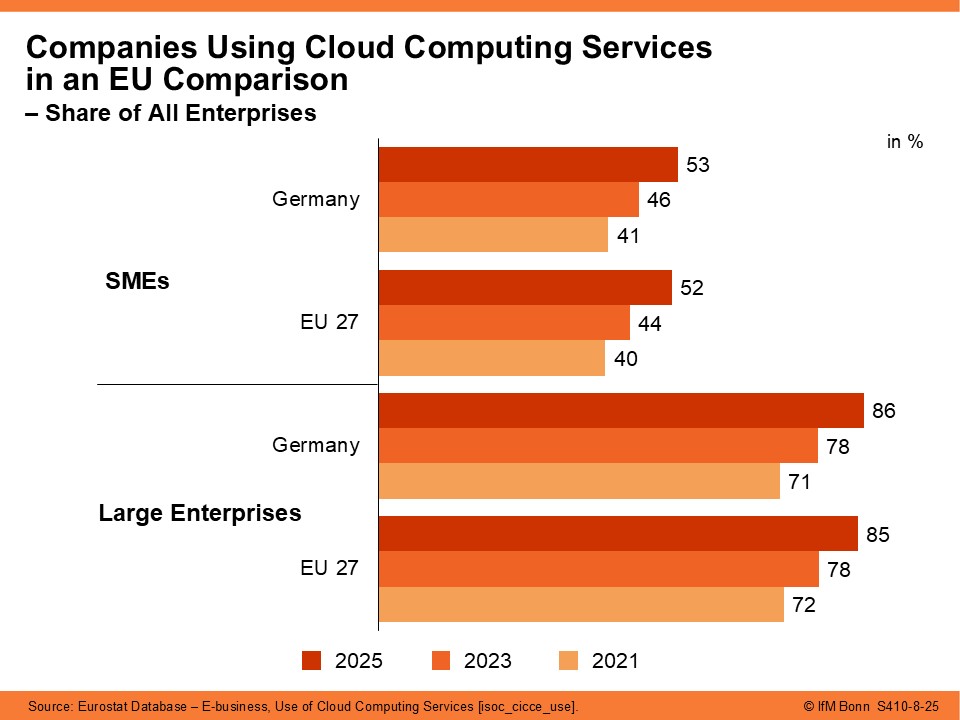
In 2025, SMEs in Germany made significantly greater use of paid cloud computing services than in 2021, with an increase of 12 percentage points. This places German SMEs slightly above the EU average.
The use of software and infrastructure from the digital “cloud” is also developing dynamically among large companies in Germany: adoption rose from 71% in 2021 to 86% in 2025. This puts them, too, slightly above the EU average.
AI Use rises sharply, more so in Large Enterprises than in SMEs
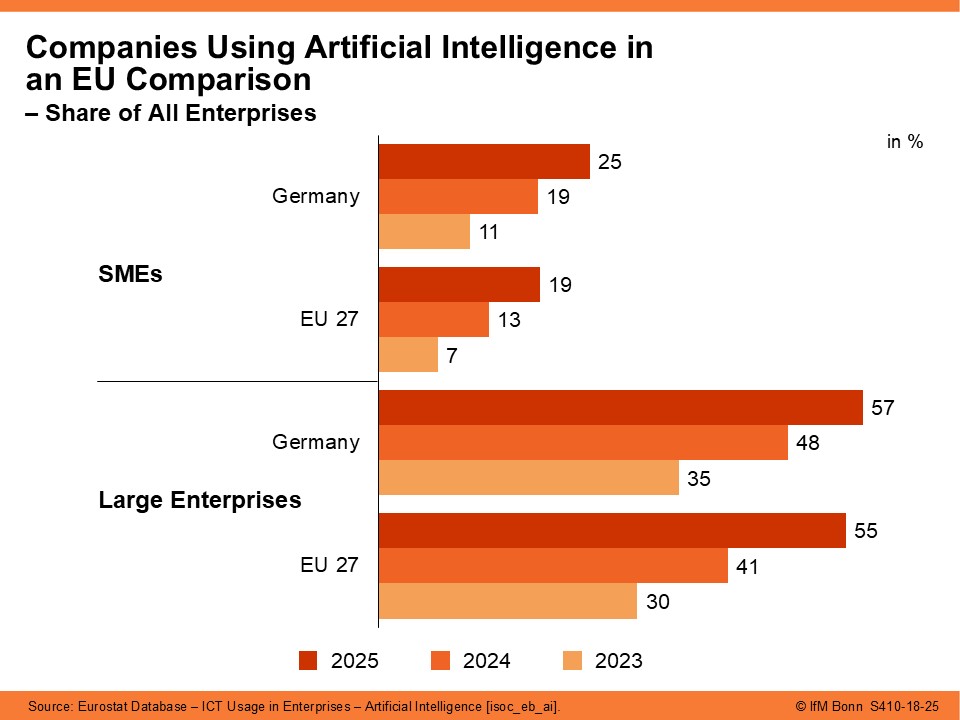
The use of artificial intelligence (AI) has gained significant momentum in recent years. In 2025, around one in four SMEs in Germany used AI applications – not only more than the EU average (19%), but also a clear increase compared to the previous year (19%). However, large enterprises in Germany continue to use AI far more frequently than SMEs. Their adoption rate stands at 57%, slightly above the EU average (55%). As a result, the gap in AI usage between SMEs and large companies continues to widen.
Rising Digital Connectivity in SMEs
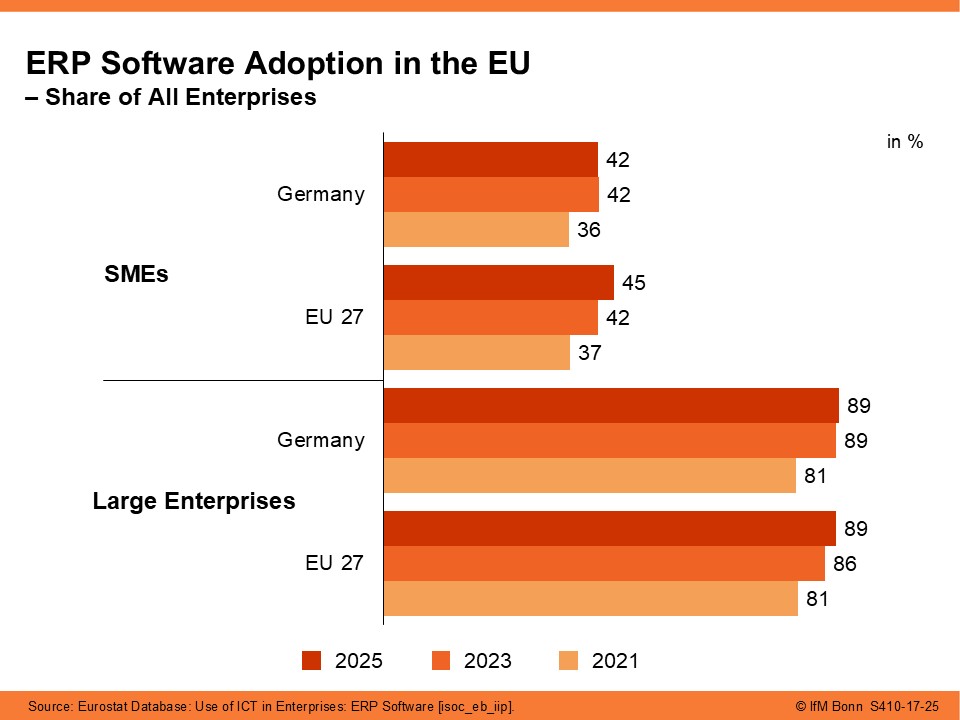
Around four in ten SMEs in Germany (42%) used Enterprise Resource Planning (ERP) software in 2025 to plan and manage their business processes. This is close to the EU average (45%). Large enterprises in Germany, however, use this software to digitally connect their company departments far more frequently (89%), which also aligns with the EU average. Compared with previous years, the use of ERP systems has stagnated in both SMEs and larger companies.
Increasing Digital Intensity of SMEs
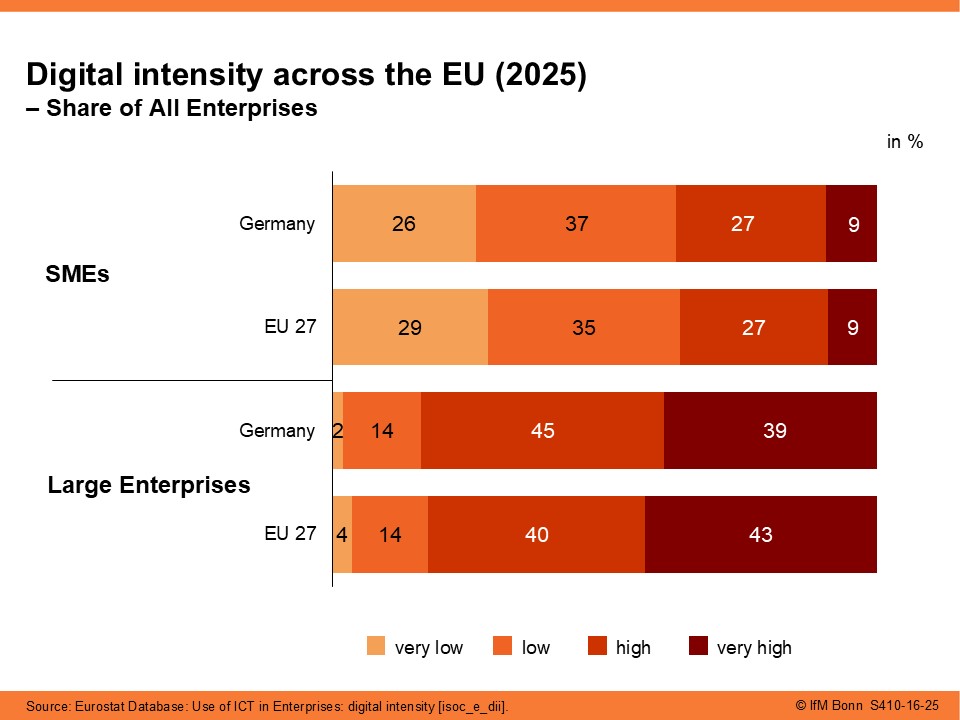
In 2025, more than one in three SMEs in Germany had a “high” to “very high” digital intensity. Very high digital intensity means that companies implement at least 10 out of 12 surveyed digitalization measures, while high intensity corresponds to 7 to 9 measures (see the data source notes for further information). German SMEs are largely similar in this regard to their EU counterparts. Nevertheless, digital intensity increases with company size: around 84% of large enterprises in Germany have a (very) high digital intensity (83% EU-wide).
Tables on Digitalization of SMEs in the EU Comparison
Select a characteristic and the desired differentiation! The corresponding table is available as a pdf file.
Table available in German only.
WebS = Website; WerbPay = Paid Advertising; DSL-BB = DSL/Broadband Access; DigInt = Digital Intensity; IKT-Besch = ICT Employees; FortbPers = ICT Training for Personnel; Online-EK = Online Purchases; Online-VK = Online Sales; CC = Cloud Computing; 3D-Dr = 3D Printing; ROB = Industrial or Service Robots
Update
Data for the year 2023 is expected to be available in early 2024.
Additional information about the data source
Contact person
Research coordinator Christian Schröder
- Telephone
- +49 228 7299743
- Get in contact