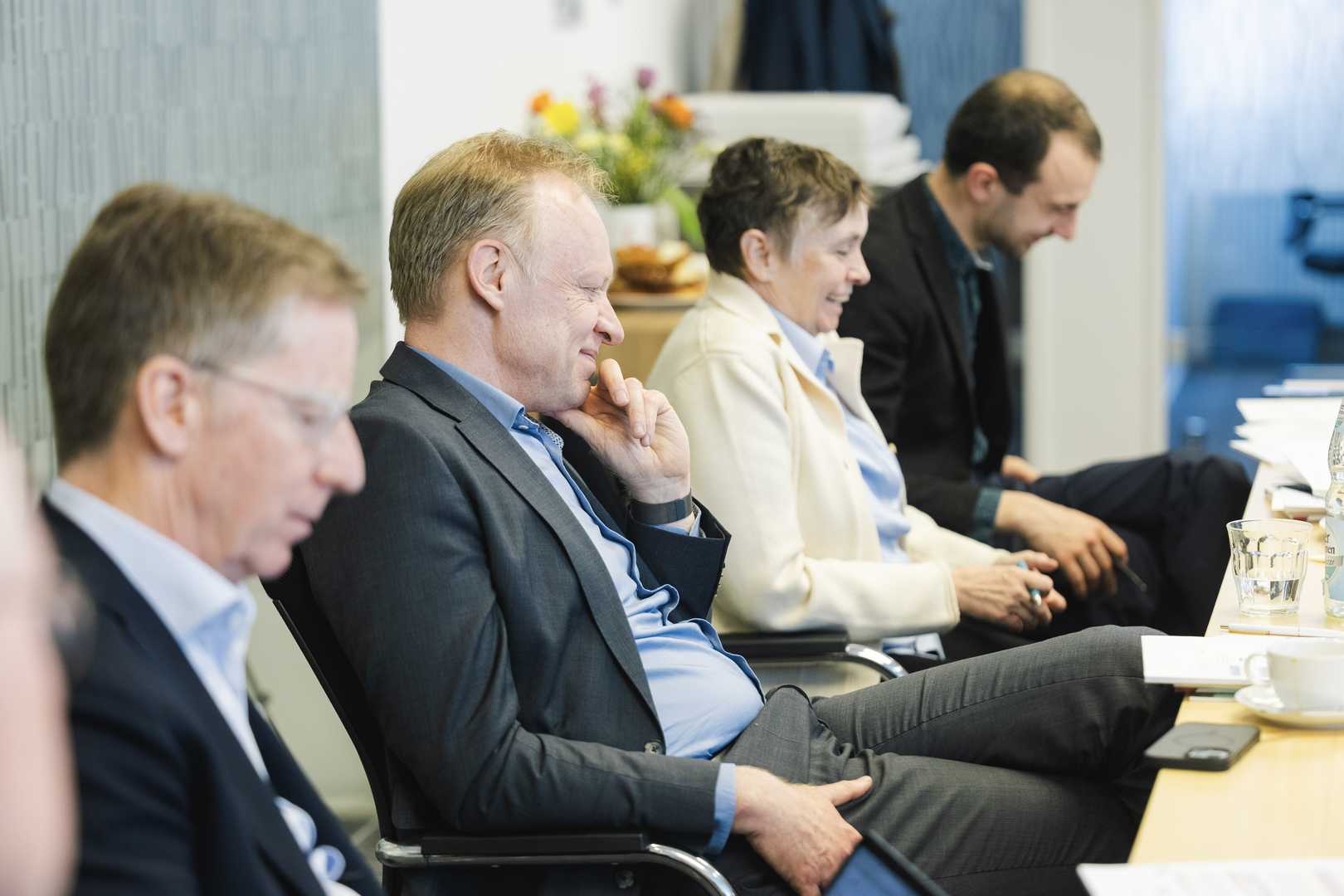
Does ethics play a role in economics? How important should it be, especially when it comes to advising policymakers? Professor Bruno S. Frey (University of Basel), Professor Clemens Fuest (Ifo Institute), Professor Friedrich Heinemann (ZEW), Professor Michael Hüther (IW Cologne), Professor Dominika Langenmayr (Cath. University of Eichstätt-Ingolstadt), Professor Margit Osterloh (University of Basel), Professor Regina Riphahn (Friedrich-Alexander University of Erlangen-Nuremberg), Professor Achim Wambach (ZEW) and Professor Friederike Welter (IfM Bonn/University of Siegen) dicussed these questions invited by Prof. Dr Nils Goldschmidt (University of Siegen) at the Global Ethic Institute in Tübingen.
Professor Clemens Fuest believes that economics has a great deal to do with ethics. He therefore argued that economics should "focus on analysing interrelationships and help to make these understandable": "Academics should not present their own values as scientific findings, but rather transparently explain the consequences that different value orientations can have," said Fuest. The IfM President also emphasised that scientific analyses should form the indispensable basis for policy advice. At the same time, however, she stressed that "the line into political positioning is crossed when advice is given without a sound scientific basis".