SME-Barometer
IfM Bonn uses the "Survey on the Access to Finance of Enterprises" (SAFE), which has been conducted since 2009 on behalf of the European Commission and the European Central Bank, to report semiannually on the current economic situation and challenges faced by SMEs in Germany and selected EU countries.
Significant improvement in the economic situation in early 2026
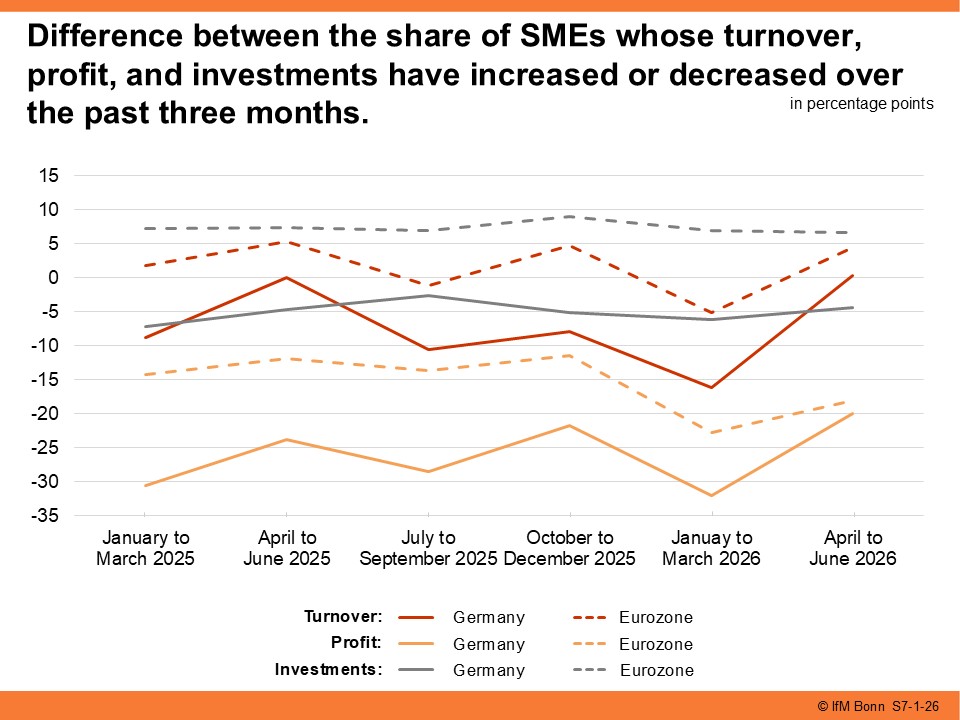
After revenue and profit figures had deteriorated at the beginning of the year, the second quarter of 2026 saw a significant improvement. However, no such improvement is evident in investment activity. This applies equally to SMEs in Germany and in the euro area. The lack of improvement in investment can be attributed to the continuing high level of uncertainty among businesses. Overall, the economic situation of SMEs in Germany continues to lag behind that of the euro area.
Figure Caption
The chart shows, for three selected indicators, the percentage of SMEs reporting an increase minus the percentage of those reporting a decrease in the respective indicator. A positive value indicates that the percentage of SMEs reporting an increase exceeds the percentage of those reporting a decrease. A negative value indicates that the proportion of SMEs showing a decline is greater than the proportion showing an increase. The higher the value, the better the economic situation of SMEs as measured by the indicator in question.
SMEs in Germany are increasingly viewing costs as a problem
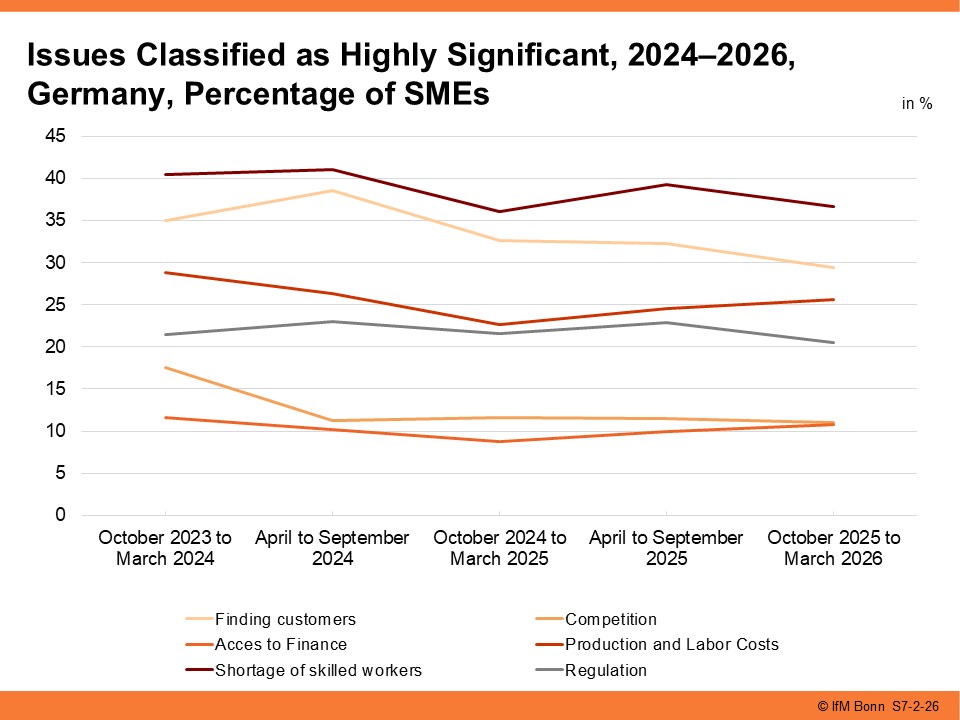
The “shortage of skilled workers” remains the most significant problem for SMEs in Germany, followed by “customer acquisition.” However, both challenges have become less significant over the past six months. Instead, “production and labor costs” have once again been perceived as a somewhat greater problem over the past year, suggesting that current geopolitical tensions are having economic consequences. By contrast, “access to financing” and “competition” continue to be viewed as secondary issues.
Customer acquisition is becoming less of a problem for SMEs in the eurozone
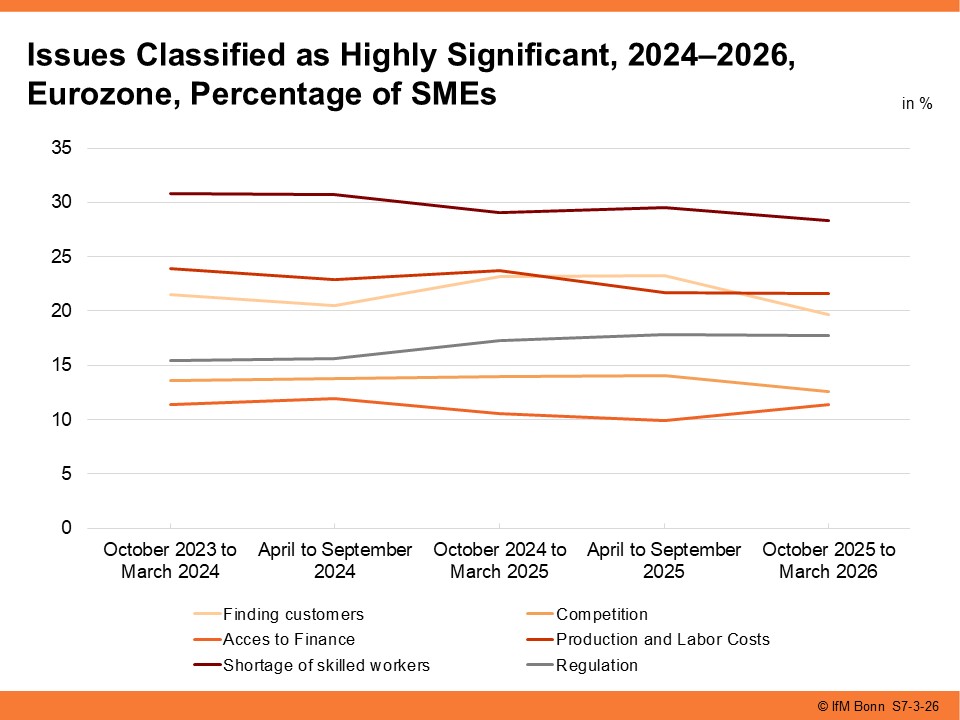
For SMEs in the euro area as well, the “shortage of skilled workers” remains the most pressing problem. This is followed by “labor and production costs.” Compared to the previous period, “customer acquisition” is perceived as less of a major problem. The share of SMEs in the euro area that classify “customer acquisition” as a major problem has fallen from more than 23% to less than 20%. Overall, the extent to which SMEs in Germany are affected by these problems is consistently higher than that of SMEs in the euro area.
The “Survey on the Access to Finance of Enterprises” (SAFE) is a Europe-wide survey conducted by the European Central Bank (ECB) twice a year (questions on difficulties) and four times a year (questions on revenue, profit, and investment). Due to their small share of total economic output, some countries are included in the survey only once a year; therefore, our analyses cover only the following countries: Austria (AT), Belgium (BE), Germany (DE), Spain (ES), Finland (FI), France (FR), Greece (GR), Ireland (IE), Italy (IT), the Netherlands (NL), Portugal (PT), and Slovakia (SK). Only small and medium-sized enterprises (SMEs) as defined by the EU are included.
Publications
SME-Barometer November 2025 “The economic situation of SMEs deteriorated again in the third quarter”
SME-Barometer July 2025 “The economic situation of SMEs continues to improve in the second quarter”
SME-Barometer May 2025 "The economic situation of SMEs slightly improved in the first quarter"
Spring 2024 - “Current Situation and Challenges of SMEs in Germany”