Publications
IfM Bonn publishes its research findings primarily in its publication series: study results are published as "IfM-Materials" - or in condensed form as a "Denkpapier" (summary). Statistical analyses and results appear in the series "Daten und Fakten". Discussion and technical papers from all research areas are published as "Working Papers".
In addition, until 2012 selected articles were published in the series "Schriften zur Mittelstandsforschung" (Gabler Verlag). Under the "External Publications" tab, you find numerous essays by IfM researchers that have appeared in (peer-reviewed) specialist journals and external publication series.
618 Results
External publication | 2020 A research note on entrepreneurs’ financial commitment and crowdfunding success
Established early stage investors decide to invest in new ventures after evaluating the propensity of success and the risk of failure.
External publication | 2020 Why the self-employed are happier: Evidence from 25 European countries
Using survey data from 25 European countries, we can show that in most of the countries the self-employed are more satisfied with their jobs than employees. This paper aims to discuss the reasons why this is the case.
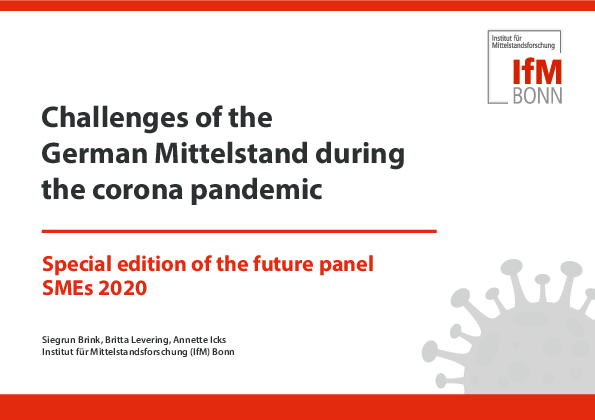
Chartbooks | 2020 Challenges of the German Mittelstand during the corona pandemic
The coronavirus pandemic and the measures associated with it pose particular challenges for German SMEs. The IfM Bonn has examined these challenges within the framework of a special edition of the survey “Zukunftspanel Mittelstand“.
IfM-Materialien | 2020 The societal impact of German Mittelstand: Conceptual considerations
This study conceptually explores the societal impact of Mittelstand companies. It aims to analyse the societal role of the German Mittelstand beyond measurable effects (CSR, CC) and to develop a basis for subsequent empirical studies.
External publication | 2020 Contextualizing Entrepreneurship Theory
This book shows that the ongoing contextualization of entrepreneurship research should not simply generate a proliferation of unique theories – one for every context – but can instead result in better theory construction, testing
Working Papers | 2020 Geographical Contexts of Entrepreneurship: Spaces, Places and Entrepreneurial Agency
The article focuses on contexts of entrepreneurship, in particular geographical contexts, and entrepreneurial agency.
External publication | 2020 International assignments of employees and entrepreneurial intentions: the mediating role of human capital, social capital and career prospects
Little is known about the entrepreneurship intentions of employees who have been on long-term international assignments, particularly after they leave paid employment upon their return from abroad.
IfM-Materialien | 2020 Mittelstand Future Panel 2020 - Update of the expert survey on current and future challanges for der German Mittelstand
Securing innovation and competitiveness is the greatest challenge for the Mittelstand, both now and in the future.
External publication | 2020 How to Make your Doctoral Research Relevant
Everyone wants their research to be read and to be relevant. This new guide presents a broad range of ideas for enhancing research impact and relevance.
IfM-Background-Paper | 2020 Comments of the IfM Bonn on the economic recovery, crisis management and future package
The German government supplemented measures to the Covid 19 emergency aid package in the spring of 2020 with the Economic Recovery and Crisis Management Package in June 2020 to revive the economy and preserve jobs in the long term.
IfM-Materialien | 2020 From idea to profit - an empirical analysis of the development processes of start-ups
The study analyses start-up processes in the alternative energy and information technology sectors. The findings reveal that start-ups do not follow a uniform process.
External publication | 2020 Academic Entrepreneurship
We examine the entrepreneurial process and success by following researchers in Germany over a three year time horizon. We show that every third scientist develops a business idea.
External publication | 2020 Self-employment at the age of 65 and more – prevalence, structure and development trends, 1997-2017
In the past, the age of 65 was perceived by the population as the end point of working life and the beginning of the retirement phase so that the employment rates from this age on were very low.
Working Papers | 2020 Moving Contexts Onto New Roads – Clues From Other Disciplines
This paper responds to Welter’s (2011) call to pay more attention to the diversity of entrepreneurship in theorizing contexts by examining how places come to be understood as entrepreneurial.
IfM-Materialien | 2020 Labor shortages in knowledge-intense occupations - Reactions of the demand and supply side
This conceptual study explores the relationship between labor shortages in knowledge-intensive occupations, the individual entrepreneurial choice, and strategic consequences for SMEs.
External publication | 2020 Means-tested benefits for self-employed: permanent condition or intermezzo?
Sometimes not only employees but also self-employed persons get in a situation where they have to rely on means-tested benefits in addition to their earned incomes.
Working Papers | 2020 The Diana project: a legacy for research on gender in entrepreneurship
The working paper provides a brief history of the evolution of the Diana Project and the Diana International Research Conference.
Working Papers | 2020 Contexts and gender – Looking back and thinking forward
The working paper shows how the gender context debate has developed from its initial focus on the contextualization of gender to the consideration of gender in context.
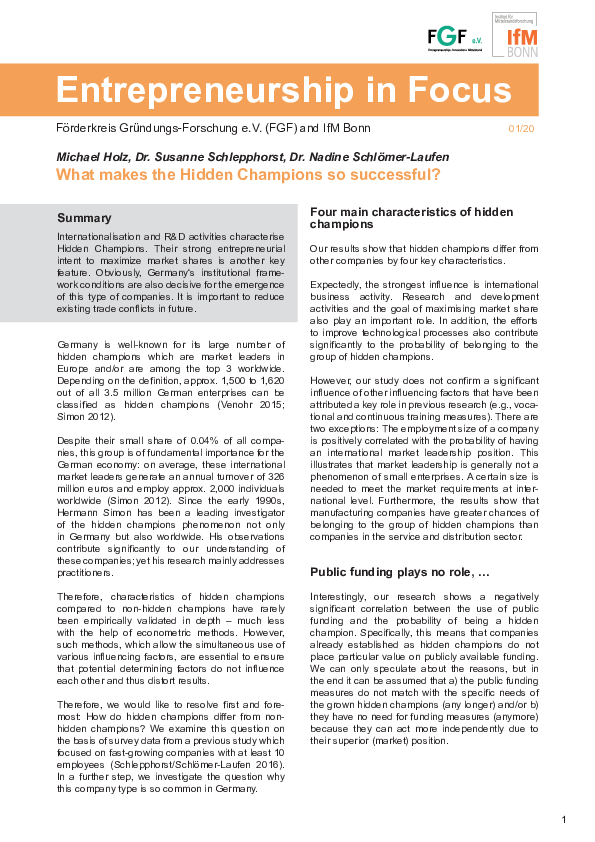
Policy Brief "Entrepreneurship in Focus" | 2020 What makes the Hidden Champions so successful?
Internationalisation and R&D activities characterise Hidden Champions.
IfM-Materialien | 2020 Determinant of regional start-up activities – A feasibility study
In view of regional differences in start-up activities the question about underlying reasons emerges. However, to shed light on those reasons there are several challenges to be overcome. The aim of this feasibility study is therefore to examine the means to overcome those challenges.