Publications
IfM Bonn publishes its research findings primarily in its publication series: study results are published as "IfM-Materials" - or in condensed form as a "Denkpapier" (summary). Statistical analyses and results appear in the series "Daten und Fakten". Discussion and technical papers from all research areas are published as "Working Papers".
In addition, until 2012 selected articles were published in the series "Schriften zur Mittelstandsforschung" (Gabler Verlag). Under the "External Publications" tab, you find numerous essays by IfM researchers that have appeared in (peer-reviewed) specialist journals and external publication series.
618 Results
External publication | 2021 The SME policy after Corona - for a sustainable future
Covid 19, digitalisation, Green Deal – the Mittelstand will face great challenges in the coming years in addition to their sector and size-specific tasks.
External publication | 2021 Moving Contexts Onto New Roads – Clues From Other Disciplines
This paper responds to Welter’s (2011) call to pay more attention to the diversity of entrepreneurship in theorizing contexts by examining how places come to be understood as entrepreneurial.
IfM-Materialien | 2021 Fintechs: Opportunities for SME Financing?
The study examines the potential of fintechs for SME financing. Fintechs often bring together capital supply and demand more efficiently than banks.

Policy Brief "Entrepreneurship in Focus" | 2021 Entrepreneurship and knowledge as drivers of regional development in East Germany
East German regions, which had a relatively high density of private enterprises and a high qualification level of the workforce at the end of the GDR era, coped relatively well within the abrupt transition to a market economy more than 30 years ago.
External publication | 2021 A replication study on growth paths of young firms: Evidence from German administrative data
This replication study contributes to the lively debate about firm-specific growth paths of new firms. Utilizing rich German administrative panel data (i.e., 895,459 young firms that submitted a turnover tax preregistration form between 2001 and 2011), the study empirically revisits new firms’ growth paths as documented in the JBV Insights paper of Coad et al. (2015).
Working Papers | 2021 Female and male entrepreneurs in Germany: How did the coronavirus pandemic affect their businesses?
Restrictions in the wake of the coronavirus pandemic have affected and continue to affect the operations of entrepreneurs. A wide range of support measures were designed to mitigate their consequences. This paper traces the economic development in the various sectors and provides an overview of the support measures.
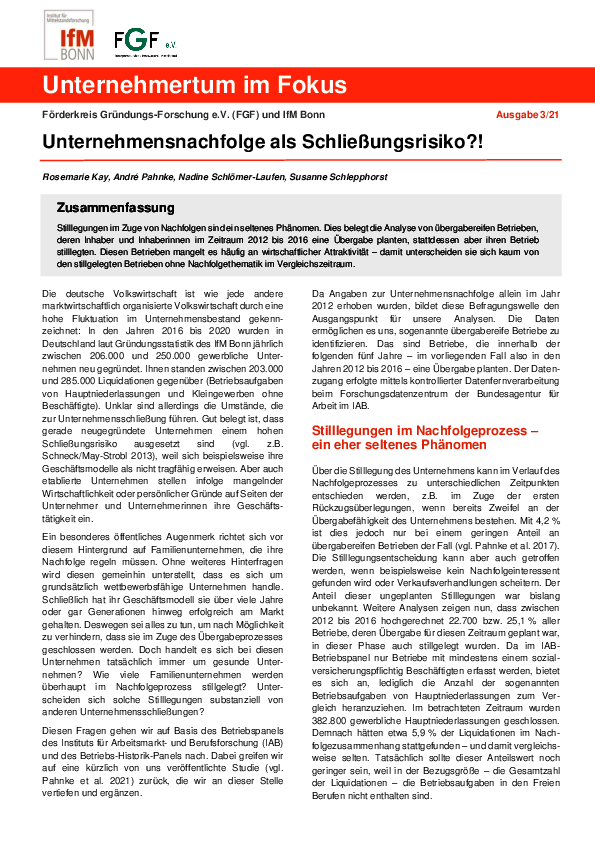
Policy Brief "Entrepreneurship in Focus" | 2021 Succession as closure risk
Closures in the course of successions are a rare phenomenon. The analysis of businesses that were ready to be handed over and whose owners planned a handover in the period from 2012 to 2016 but closed down their business instead proves this.
IfM-Materialien | 2021 Founding success of academics in German univiersities - a process oriented perspective
Im Rahmen dieser Studie werden die Einflüsse auf den Gründungserfolg von Wissenschaftlerinnen und Wissenschaftlern an deutschen Hochschulen über einen Zeitraum von sieben Jahren analysiert.
External publication | 2021 Inventions and their commercial exploitation in academic institutions: Analysing determinants among academic
Institutions of higher education are considered to be an important source of innovation and thereby a key driver of economic growth and development. Consequently, efforts are made to facilitate technology transfer from universities into the market.
External publication | 2021 Different strokes for different folks: The job satisfaction of the selfemployed and the intersection of gender and migration background
Migrant enterprises comprise about 10 per cent of all enterprises in Germany and are therefore a crucial part of the German economy and its entrepreneurial ecosystems.
External publication | 2021 Entrepreneurship Education: Definition - Theory - Perspectives
This anthology captures the current discussion about entrepreneurship education in the context of economic education in Germany.
External publication | 2021 Conceptual and disciplinary genesis of entrepreneurship education
Entrepreneurship education is a diverse and interdisciplinary field of teaching and research.
IfM-Background-Paper | 2021 Mittelstand policy during and after the Covid 19 pandemic
During the pandemic, Mittelstand policy is above all a policy of acute crisis management for the Mittelstand economy.
IfM-Background-Paper | 2021 Commercial start-ups and company closings in 2020
The coronavirus pandemic has a significant impact on economic activity in Ger-many. In view of the poor business prospects, the number of market entries (start-ups) should have decreased and the number of exits should have increased.
IfM-Background-Paper | 2021 Perspectives for Mittelstand businesses in the Covid-19 pandemic. Part 2: Challenges for Mittelstand Enterprises
The pandemic has been posing great challenges to Mittelstand businesses since spring 2020. While the focus was initially on the economic restrictions, over time the social and individual effects are also coming into view.
IfM-Materialien | 2021 Challenges related to Business Transfers: Companies between continuation and closure
The transfer of a business involves a multitude of challenges. Among them, it is essential to find a successor willing to take over the business to avoid a closure.
IfM-Background-Paper | 2021 Prospects for SMEs in the Covid 19 pandemic. Part 1: Challenges for SME policy
The demands of business associations and SMEs for a perspective on opening up the currently closed sectors of the economy are becoming louder and louder at the beginning of the second Corona pandemic year.
External publication | 2021 Digital B2B-Platforms - Status quo and Perspectives for the Industry in Germany
Compared to digital C2C platforms, B2B market segments are smaller and more specific. Therefore, network effects have a weaker impact on B2B platform mar-kets, which means that monopolisation tendencies are also lower.
Policy Brief "Entrepreneurship in Focus" | 2021 The (underestimated) potential of craft roll data for start-up and SME research
The business statistics of the Chambers of Skilled Crafts and Small Businesses hold a worthwhile data potential for start-up and SME research
External publication | 2021 A Research Agenda for Entrepreneurship Policy
This book makes the case for a change in the research agenda on entrepreneurship policy. An exemplary group of authors addresses the agenda for entrepreneurship policy researchers, policy makers and practitioners in the field.