1171 Results


Working Papers | 2024 Being the boss at work and at home – Self-employment and conflicts between partners
The self-employed are their own bosses and make independent decisions on how to achieve their goals
Chartbooks | 2024 Mittelstand Future Panel 2024: Companies struggle with competitive pressure, bureaucracy and business conditions
The IfM Bonn researchers asked again company managers to take part in the Future Panel Mittelstand in 2024.
IfM-Materialien | 2024 The bureaucratic barriers for SMEs in the construction sector as a result of their participation in public procurement
Participation in public tenders at municipal level is associated with bureaucratic burdens.
External publication | 2024 The equity crowdfunding choice: A demand-side perspective
In recent years, equity crowdfunding has become increasingly popular for capital-seeking start-ups.
IfM-Materialien | 2024 Entrepreneurial ecosystems and start-up activity – a long-term analysis of their interrelationships
Supporting start-up activity is a central goal of regional economic policy. The focus here is on regional start-up ecosystems, which combine many potential influencing factors.
External publication | 2024 Determinants of Hidden Champions
This study explores the factors that affect the likelihood of German companies to be a hidden champion.

Working Papers | 2024 Family business succession planning: Are the outcomes dependent on the predominant gender in the management board?
While existing research on business successions stresses the importance of the economic situation of family business in this context, research on women’s entrepreneurship, however, suggests that women-led businesses may be less economically attractive for potential successors because of structural differences in comparison to men-led business.
Policy Brief "Entrepreneurship in Focus" | 2024 Financed maternity benefits for self-employed women?
Self-employed women may voluntarily insure themselves through their health insurance against a loss of earnings during the maternity protection period.
External publication | 2024 Legitimacy of women entrepreneurs: forced to behave according to rules?
Legitimacy is essential to ensure the continued existence of companies. Depending on whether stakeholders consider entrepreneurs’ behavior to be appropriate, they decide whether to provide entrepreneurs with resources.

IfM-Materialien | 2024 Effects of institutional framework conditions and resource availability on the gender gap in self-employment – a systematic literature analysis
This study uses a systematic literature review of international publications to examine the effects of institutional framework conditions and the availability of resources on the gender gap in entrepreneurship.

Facts and figures | 2024 Maternity benefits for self-employed women
Self-employed women can voluntarily insure themselves against loss of income during the maternity protection period through health insurance. Around half of self-employed women of childbearing age are insured accordingly.
SME Development Barometer
SMEs in Germany are increasingly viewing costs as a problem The “shortage of skilled workers” remains the most significant problem for SMEs in Germany, followed by “customer acquisition.” However,…
External publication | 2024 The protection against social risks: a particular challenge for hybrid employees?
Hybrid self-employment - the parallel pursuit of self-employment and paid employment - has steadily increased over time.

IfM-Background-Paper | 2024 Estimation of the number of commercial start-ups and company closures in 2023
The IfM Bonn is faced with the challenge of continuing its statistics on business start-ups and company closures in the commercial sector for the year 2023, as the business advertisement statistics from the end of 2022 and also in 2023 were affected by recording errors.
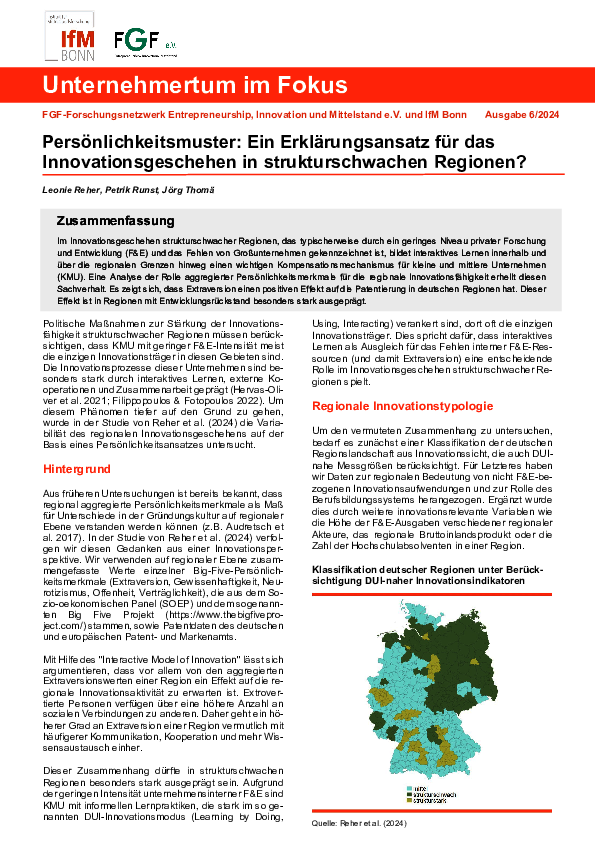
Policy Brief "Entrepreneurship in Focus" | 2024 Patterns of personality: An explanatory approach to innovation in lagging regions?
In the innovation process of lagging regions, which are typically characterized by low levels of private research and development (R&D) and the absence of large firms, interactive learning within and across regional borders serves as an important compensatory mechanism for small and medium-sized enterprises (SMEs).
External publication | 2024 Collaborative innovation processes: An opportunity for successful dual transformation in the SME sector
The framework conditions under which SMEs innovate have been undergoing serious changes for some time now: The digital and green transformation is changing products, production and communication processes. This change, coupled with a growing shortage of skilled labour, is increasingly encouraging and demanding the development of collaborative innovations.