1171 Results
Working Papers | 2019 The Effect of Migrants' Resource Endowments on Business Performance
This paper questions the stereotypical image of migrant-led companies as being less successful than native-led businesses.
External publication | 2019 The Missing Entrepreneurs 2019
The Missing Entrepreneurs 2019 is the fifth edition in a series of biennial reports that examine how public policies at national, regional and local levels can ...
External publication | 2019 Crises of SMEs: challenges, developments, and resilience of women- and migrant-led companies
This study examines the process of a business crisis of small companies of all sectors of the economy in the Frankfurt/Main (Germany) area. Particular emphasis is laid on the challenges faced by migrant- and women-led companies.
External publication | 2019 SME and Entrepreneurship Policy in Ireland
SMEs and entrepreneurs play a crucial role in the Irish economy, with SMEs accounting for more than 70% of employment.
Denkpapiere | 2019 Chinese Direct Investments in Germany: Opportunities and Risks for SMEs
With its many (medium-sized) technology leaders, Germany is increasingly attracting the interest of Chinese investors.
Working Papers | 2019 Emotions and Entrepreneurship Education: State of the Art and Future Research Agenda
In their contribution, Victor Pérez and Juha Kansikas not only give an overview of the results of previous research on "Entrepreneurship Education and Emotions" ...
Denkpapiere | 2019 The Renaissance of Protectionism: Impact on SMEs
This article examines the challenges facing internationally active SMEs in an environment increasingly characterized by trade policy conflicts and uncertainty.

IfM-Materialien | 2019 Determinants of SME financing across selected European countries
This study examines the impact on small and medium-sized enterprise (SME) financing in nine selected European countries.
Ongoing economic monitoring | 2019 Further development of IfM Bonn foundational statistics
Start-up statistics by the IfM Bonn are one of the most important sources of data on start-ups in Germany in terms of reliability and coverage.
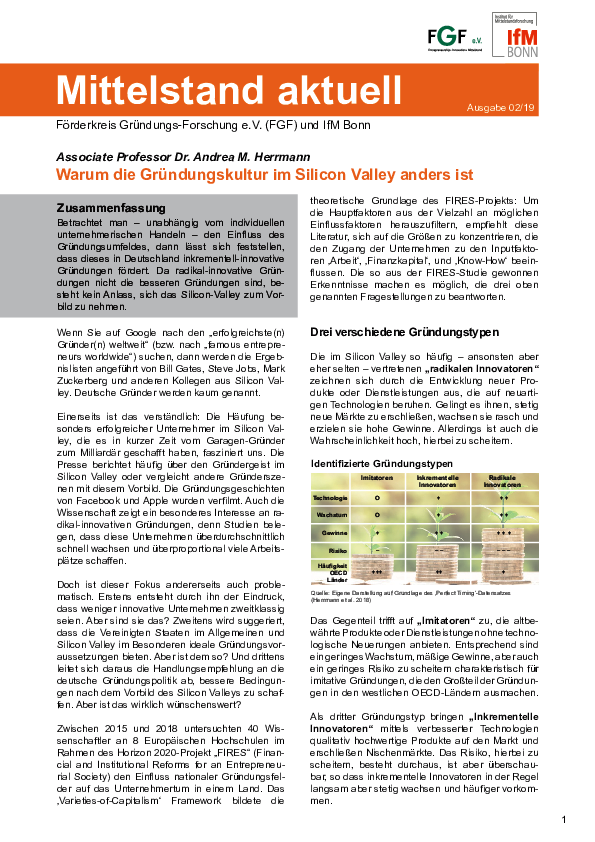
Policy Brief "Entrepreneurship in Focus" | 2019 Why the start-up culture in Silicon Valley is different
Looking at the influence of the start-up environment - independent of individual entrepreneurial activity - it can be seen that the environment in Germany promotes incremental-innovative start-ups.

IfM-Materialien | 2019 Entrepreneurial target systems: Are medium-sized companies really different from others?
German SMEs are characterized - both nationally and internationally - as a special group of companies that stand out due to specific characteristics, behaviors and values.
External publication | 2019 A gendered look at entrepreneurship ecosystems
Underlying entrepreneurship ecosystems is the implicit assumption that all entrepreneurs have equal access to resources, participation, and support, as well as an equal chance of a successful outcome (venture start-up).
IfM-Materialien | 2019 Bureaucratic perception of companies
This study examines how companies perceive bureaucracy. Three different kinds of perception types can be identified, depending on the degree of perceived overall burden, the extent of efforts required to fulfil bureaucratic requirements and the degree of emotion caused by bureaucracy; the Unencumbered Type, the Pragmatic Type and the Grumbling Type.
External publication | 2019 Entrepreneurship and Context
"Entrepreneurship and Context" conveys the significant contribution Friederike Welter has made to entrepreneurship research in recent decades.
Facts and figures | 2019 Business start-ups by women - current developments
Women have always been underrepresented in the founding process in Germany. This under-representation has recently increased again.
External publication | 2019 The power of words and images: towards talking about and seeing entrepreneurship and innovation differently
Words and images are powerful: they frame the ways we perceive what entrepreneurship and innovation is and what not.
Denkpapiere | 2019 Company succession by employees - opportunities and risks
Between 2018 and 2022, the IfM Bonn estimates that every year around 30,000 family businesses in Germany will be faced with a succession issue.
External publication | 2019 Potentially Disruptive Innovations and Business Models
This study analyses how established SMEs respond to potentially disruptive innovations and business models in the course of increasing digitization.
External publication | 2019 Different strokes for different folks: The job satisfaction of the selfemployed and the intersection of gender and migration background
Migrant-run businesses are an important component of entrepreneurial ecosystems in Germany - One in ten of the companies in Germany is migrant-run.
External publication | 2019 Implementation aids Work 4.0 Use artificial intelligence for productive and preventive work design: Background knowledge and design recommendations for the introduction of 4.0 technologies
Small and medium-sized companies are faced with the major task of mastering the challenges of the digital transformation in the working world and using it as an opportunity. The increasing use of new 4.0 technologies based on artificial intelligence (AI) influences many areas of our work and everyday life.