1171 Results
External publication | 2018 Contextual Entrepreneurship: An Interdisciplinary Perspective
Over the past decade, context research has developed into an important field of science.
IfM-Materialien | 2018 How small and medium-sized enterprises deal with demographic challenges - A trend study
The IfM Bonn investigates on the basis a representative trend study for the period 2007 to 2017, how SMEs meet the demographic change.
Working Papers | 2018 The Impact of Firm Performance on the Business Transfer Mode
This paper examines the influence of corporate performance on the desired type of business transfer. Family businesses usually strive for succession within the family.
IfM-Materialien | 2018 The influence of the founding process on regional economic growth
This study examines the influence of the founding process on economic development. For this purpose, the 402 German districts and cities were considered. The study shows that districts with high rates of start-ups do not automatically generate higher growth.

IfM-Materialien | 2018 Newly founded companies and their development: An empirical analysis based on different dimensions of success
This study is dedicated to the development of newly founded companies in the first four years. The aim was to analyze how the companies develop in the post-foundation phase on the basis of different success dimensions (survival in the market, coverage of living expenses and job creation).

External publication | 2018 The largest family businesses in Germany - Company Survey 2017: Cooperation with Start-ups
As part of the study series "The largest family-owned companies in Germany", the IfM Bonn conducted a survey of around 250 of the 4,700 largest family-owned companies in spring 2018 for the ninth time.
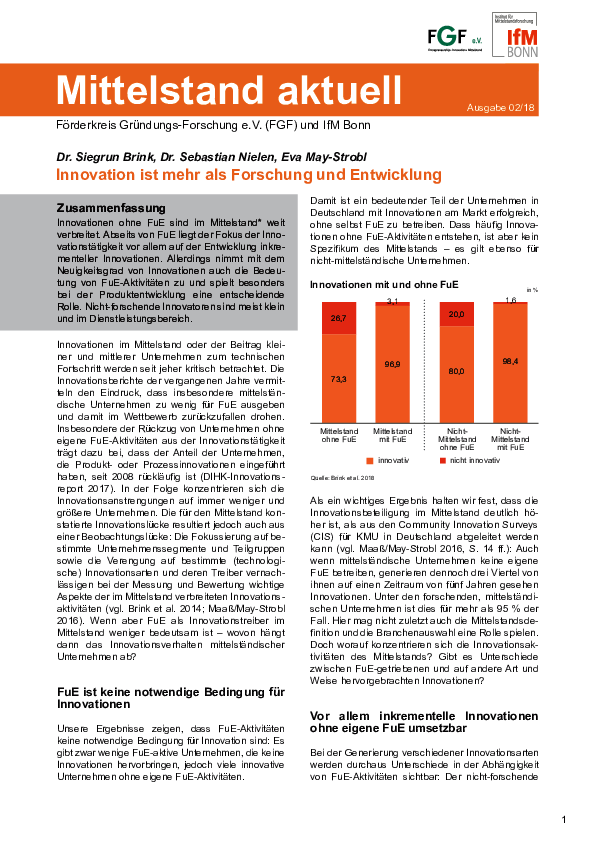
Policy Brief "Entrepreneurship in Focus" | 2018 Innovation is more than research and development
Innovations without R&D are widespread in medium-sized companies. Beyond R&D, the focus of innovation activity is primarily on the development of incremental innovations.
External publication | 2018 The use of self-management by small and medium-sized enterprises 2013-2016
The law to further facilitate the restructuring of companies (ESUG) changed the types of proceedings that allow companies threatened by insolvency to continue.
Working Papers | 2018 A Research Note on Entrepreneurs' Financial Commitment and Crowdfunding Success
Established early stage investors decide to invest in new ventures after evaluating the propensity of success and the risk of failure. Consequently, it is of considerable importance that the new business owners have substantial 'skin in the game' and are thus highly committed to business success.
Facts and figures | 2018 Regional analysis of start-up activities in North Rhine-Westphalia - 2015 to 2017
The IfM Bonn has analyzed the founding events in the economic regions of North Rhine-Westphalia by means of special evaluations of the trade advertisement statistics and information from the tax authorities.
Working Papers | 2018 Brain-Driven Entrepreneurship Research: Expanded Review and Research Agenda Towards Entrepreneurial Enhancement
The advent of significant advances in neuroscience has produced the capacity to examine the human brain at a profound level, yet the academic and practical value of existing evidence based on neuroscience techniques and methods within the field of entrepreneurship remains unexplored.
IfM-Materialien | 2018 The investment behavior of small and medium-sized enterprises
This study examines the investment behavior of small and medium-sized enterprises based on the balance sheet figures of German companies for the period from 2005 to 2014, showing that SMEs invest less than large companies, especially since the financial crisis of 2009/2010.
IfM-Materialien | 2018 Influence of the regional banking system on SME financing
As a result of the financial crisis, British companies had much more problems obtaining loans than German companies. The study shows that one reason for this could be the German regional banking system and its specific characteristics.
IfM-Materialien | 2018 Regional start-up environments using the example of selected hotspots
In the context of the study, start-up environments are examined on the basis of five selected start-up hotspots. The study showed that universities offer a variety of advantages for the regions as start-up locations, especially when they cooperate closely with regional players in the start-up process.
Facts and figures | 2018 Business start-ups by foreign citizens: Update 2018
Foreigners have played a significant role in shaping the business start-up process in both Germany and North Rhine-Westphalia between 2007 and 2016. Foreign founders have played a particularly important role in the commercial sector.
External publication | 2018 [Übersetzen nach: English] Entrepreneurial resourcefulness in unstable institutional contexts: The example of European Union borderlands
This paper aims to understand entrepreneurial resourceful behavior in contexts characterized by difficult economic conditions and institutional changes.
Facts and figures | 2018 The use of bankruptcy reorganisation channels by small and medium-sized enterprises - the example of self-administration
With the introduction of the ESUG, Germany's insolvency law was reformed in 2012. The ESUG opens up new reorganization paths, e.g. the self-administered protective shield procedure before insolvency and self-administration during the opening proceedings.
External publication | 2018 Women entrepreneurs´ financing revisited: taking stock and looking forward
Do financing agencies discriminate against women entrepreneurs, or is this simply a perception? Does the persistent underrepresentation of women in the financing industry, especially in venture capital, play a role?
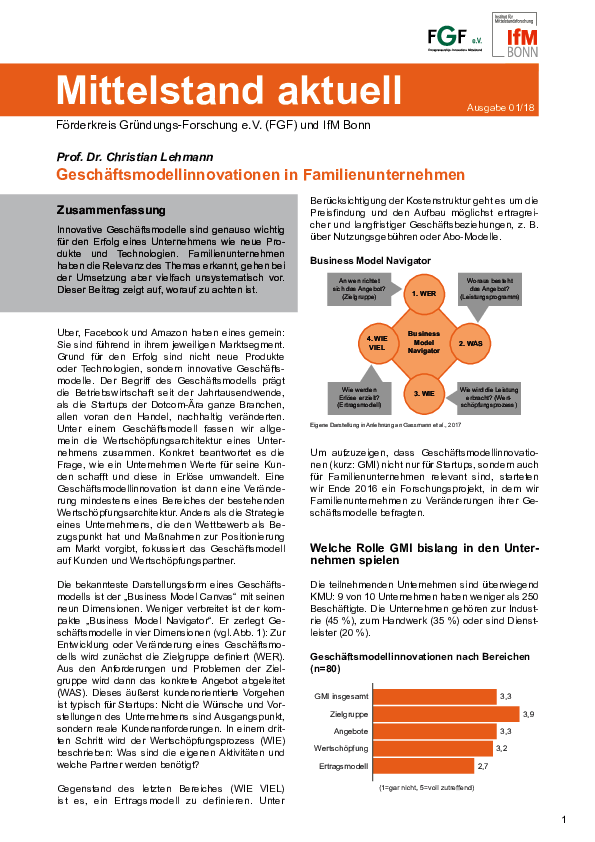
Policy Brief "Entrepreneurship in Focus" | 2018 Business model innovations in family businesses
Innovative business models are just as important for the success of a company as new products and technologies.
Facts and figures | 2018 Company successions in Germany 2018 to 2022
Due to a lack of official statistics, the IfM Bonn has been estimating the number of companies in Germany that are about to be handed over since the mid-1990s. The present estimate for the period 2018 to 2022 concludes that about 150,000 companies with about 2.4 million employees are about to be handed over.