1171 Results

Working Papers | 2016 Individual and Structural Influences on the Entrepreneurial Activities of Academics
Scientific university staff generates innovations within the scope of their research activities and possesses up-to-date knowledge that can be regarded as the basis for innovative business start-ups.
IfM-Materialien | 2016 SME policy in practice - framework setting or promotion?
The present analysis develops elements of a future-oriented SME policy at the federal state level. So far, SME policy has concentrated on subsidy policy, compensation for disadvantages or "picking the winner"

Working Papers | 2016 Economic effects of the 2004 Crafts Amendment: Results from a quasi-natural experiment
The 2004 reform of the Crafts Code brought about a comprehensive liberalization of access conditions for more than half of the craft trades sectors, in particular by abolishing the obligation to be a master craftsman.
External publication | 2016 Women´s Entrepreneurship in Global and Local Contexts
All over the world, the phenomenon "entrepreneurship" has developed a high momentum of its own.
External publication | 2016 Everyday Entrepreneurship - A Call for Entrepreneurship Research to Embrace Entrepreneurial Diversity
The authors plead in their contribution for taking a comprehensive and open perspective within the Entrepreneurship Research towards the question, what constitutes entrepreneurship.
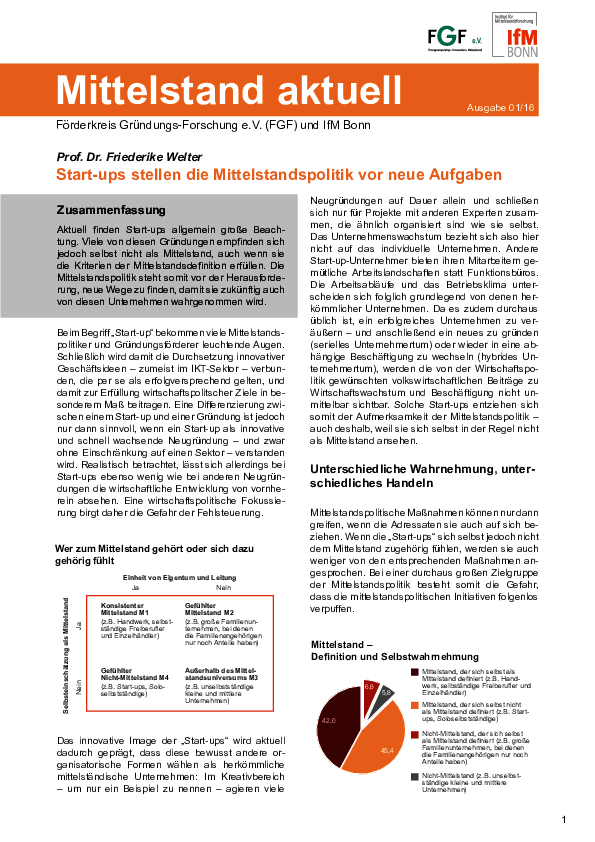
Policy Brief "Entrepreneurship in Focus" | 2016 Start-ups pose new challenges for SME policy
Currently, start-ups in general are receiving a lot of attention. However, many of these start-ups do not consider themselves to be SMEs, even if they meet the criteria of the definition of SMEs.

Working Papers | 2016 Fine Artists' Entrepreneurial Business Environment
This paper aims to illustrate the working and business environment of professional fine artists and to identify the factors to successfully make a living in the arts as both market challenges and success factors have not yet been clearly identified in literature.

Working Papers | 2016 Digitization in the German specialist radio trade
In this current IfM Working Paper, recommendations for action are given to solve the problem of repositioning German radio retailers.
IfM-Materialien | 2016 "The 21st century is female" - Women entrepreneurs in the press
The present study examines the press reporting on entrepreneur inside in particular with view of it, which picture of entrepreneur interiorness in the press reports is obtained.
External publication | 2016 Wandering between Contexts
The diversity of entrepreneurship is caused on the one hand by the individual actions of the entrepreneurs. On the other hand, the framework conditions within which a company is founded or managed also have an impact.
Denkpapiere | 2016 Sharing economy and middle class
Sharing economy as a culture of sharing is not a new phenomenon. What is new, however, is the speed and range with which transactions are now possible.

Working Papers | 2016 Inventions and their Commercial Exploitation in Academic Institutions: Analysing Determinants Among Academics
The transfer of knowledge and the exploitation of marketable inventions from university research is an important source of innovation that enjoys broad support from the business community.

Working Papers | 2016 Determinants of hidden champions - Evidence from Germany
This explorative study analyzes the determinants that influence the probability of German companies being a hidden champion.
External publication | 2016 Women’s innovation in Germany – empirical facts and conceptual explanations
The existing data regarding gender and innovation show that women are less likely to carry out technologically based product and process innovations than men.

External publication | 2016 The largest family businesses in Germany - Spring Survey 2016
As part of the study series "The largest family-owned companies in Germany", the IfM Bonn conducted a survey of around 380 of the more than 4,500 largest family-owned companies for the seventh time in spring 2016.
IfM-Materialien | 2016 Once an entrepreneur, always an entrepreneur? Self-employment in the course of employment
The present study analyzes the employment histories of self-employed persons of different birth cohorts. Our results show that most self-employed persons have only one phase of self-employment in their life course and a large proportion of them remain permanently self-employed.
IfM-Materialien | 2016 The importance of non-technological innovations in the innovation process of medium-sized businesses
Small and medium-sized companies are considered innovative and adaptable, but an increasing innovation gap is noted. For this study, the innovation participation of SMEs was analyzed with a special focus on non-technological innovations based on the Community Innovation Surveys.
External publication | 2016 Innovation and women’s entrepreneurship – (why) are women entrepreneurs less innovative?
Empirical studies show an under-representation of women in innovative activities across all countries, however to date research is only starting to discuss gender influences on the innovativeness of persons or companies.

External publication | 2016 The largest family businesses in Germany - Spring survey 2016
As part of the study series "The largest family-owned companies in Germany", the IfM Bonn conducted a survey of around 380 of the 4,500 largest family-owned companies for the seventh time in spring 2016.

Working Papers | 2016 Gender Diversity in Top-Management Positions in Large Family and Nonfamily Businesses
(Why) does the sex ratio in top-management positions in large family and nonfamily businesses differ? Using a unique data set and estimating (fractional) logit regressions we show that the female share in top-management positions in family businesses exceeds the one in nonfamily businesses.