1171 Results
IfM-Background-Paper | 2021 Mittelstand policy during and after the Covid 19 pandemic
During the pandemic, Mittelstand policy is above all a policy of acute crisis management for the Mittelstand economy.
IfM-Background-Paper | 2021 Commercial start-ups and company closings in 2020
The coronavirus pandemic has a significant impact on economic activity in Ger-many. In view of the poor business prospects, the number of market entries (start-ups) should have decreased and the number of exits should have increased.
IfM-Background-Paper | 2021 Perspectives for Mittelstand businesses in the Covid-19 pandemic. Part 2: Challenges for Mittelstand Enterprises
The pandemic has been posing great challenges to Mittelstand businesses since spring 2020. While the focus was initially on the economic restrictions, over time the social and individual effects are also coming into view.
IfM-Materialien | 2021 Challenges related to Business Transfers: Companies between continuation and closure
The transfer of a business involves a multitude of challenges. Among them, it is essential to find a successor willing to take over the business to avoid a closure.
Prof. David Urbano
Prof. David Urbano Universitat Autònoma de Barcelona - Department of Business and Centre for Entrepreneurship and Social Innovation Research (CREIS) Research areas …
Prof. Alfredo De Massis
Prof. Alfredo De Massis Freie Universität Bozen - Faculty of Economics Research areas Succession and generational transitions Innovation through tradition Strategic decision-making in…
Prof. Michael Gielnik
Prof. Michael Gielnik Leuphana Universität Lüneburg / Member of the Research council IfM Bonn Research fields Psychology of Entrepreneurship Entrepreneurship Training and Transfer Dynamics…
Prof. Sabine Rau
Prof. Sabine Rau University of Ottawa, Canada und Université de Luxembourg / Chair of the Research council IfM Bonn Research fields Influence of the family on the innovation activity of the…
Prof. Dr. Constanze Chwallek
Prof. Constanze Chwallek University of Applied Sciences Aachen / Chair of the Research council IfM Bonn Research fields Business Model Innovation Corporate…
Michael Fritsch
Prof. Michael Fritsch Friedrich-Schiller-Universität Jena / Deputy Chair of the Research council IfM Bonn Research fields New business formation processes and their impact on economic…
IfM-Background-Paper | 2021 Prospects for SMEs in the Covid 19 pandemic. Part 1: Challenges for SME policy
The demands of business associations and SMEs for a perspective on opening up the currently closed sectors of the economy are becoming louder and louder at the beginning of the second Corona pandemic year.
Prof. Urs Fueglistaller
Prof. Dr. Urs Fueglistaller KMU-HSG, Universität St. Gallen / Member of the Research council IfM Bonn Forschungsfelder Führungskompetenz von KMU Konsequente Kundenorientierung KMU und…
External publication | 2021 Digital B2B-Platforms - Status quo and Perspectives for the Industry in Germany
Compared to digital C2C platforms, B2B market segments are smaller and more specific. Therefore, network effects have a weaker impact on B2B platform mar-kets, which means that monopolisation tendencies are also lower.
The future of Mittelstand enterprises | 2021 Future Panel Mittelstand
In order to identify forward-looking topics relevant to SMEs in terms of operative practices and economic policy, the IfM Bonn launched the Future Panel for Mittelstand enterprises in 2014.
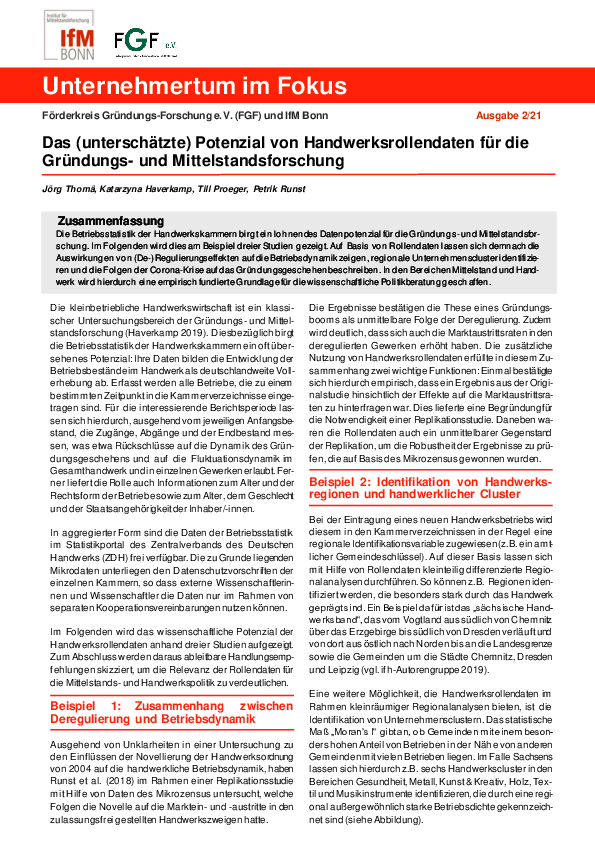
Policy Brief "Entrepreneurship in Focus" | 2021 The (underestimated) potential of craft roll data for start-up and SME research
The business statistics of the Chambers of Skilled Crafts and Small Businesses hold a worthwhile data potential for start-up and SME research
Prof. Andrea Herrmann
Prof. Andrea M. Herrmann Nijmegen School of Management at Radboud University Research Fields Political economy Institutional theory Innovation management Entrepreneurship Online labour…
External publication | 2021 A Research Agenda for Entrepreneurship Policy
This book makes the case for a change in the research agenda on entrepreneurship policy. An exemplary group of authors addresses the agenda for entrepreneurship policy researchers, policy makers and practitioners in the field.